A joke was meant.
She stole my Xbox after I shouted during a game, and I threatened to call the police for “stealing my property.” She just smiled and said, “Go ahead. Tell them I stole your pizza too.”
I didn’t think she meant I should actually call.
But I was furious. Not just annoyed—full-on red-in-the-face, can’t-feel-my-hands mad. I grabbed her phone while she was folding clothes and told the operator, “My mom took something that belongs to me.”
I probably hung up before they finished asking questions. Ten minutes later, there was a knock at the door.
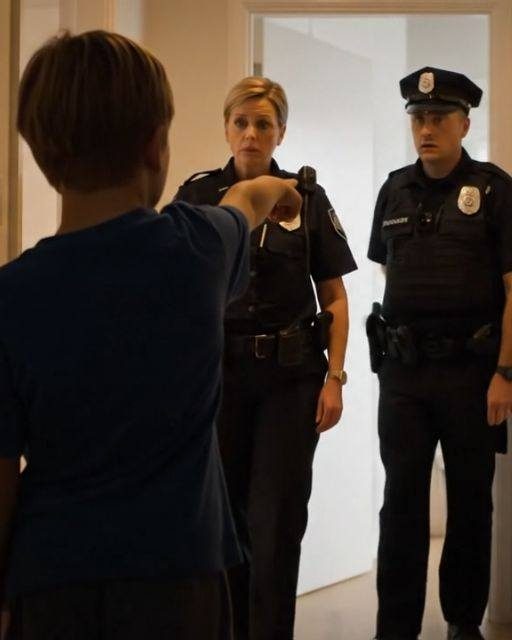
Two officers. A woman and a man. Their calm voices, sharp badges, and serious looks told me this wasn’t about a noise complaint.
I froze. Mom asked who it was, and I couldn’t answer. I just pointed down the hall—the same one she’d walked down with the laundry basket.
The officers entered cautiously. No yelling. No handcuffs. Just the sound of quiet footsteps on hardwood. My heartbeat was so loud I thought they might hear it.
At the hallway, Mom looked confused. “Can I help you?”
The female officer glanced at me and said, “Ma’am, we received a call from this address. Your child said—”
But before she could finish, the male officer spotted something on the floor inside my room. He crouched down and picked it up.
Mom went pale.
“Is this blood?”
I hadn’t noticed it, but he was right. A small reddish-brown stain on the carpet’s edge. Mom raised her eyebrows. “Have you cut yourself again?”
I nodded slowly, choking on the words. “I think… yesterday.”
The female officer gently interrupted, “We need to ask some questions, ma’am. Can we sit down?”
Mom nodded but looked frozen.
The next hour was a blur. They asked if there was violence at home, if she disciplined me physically, if I felt safe. Every time I spoke, my throat tightened. Mom barely said a word, twisting her sweatshirt hem nervously.
Later, they left. No arrests. No warnings. But they said, “We might follow up.” I saw Mom’s shoulders sag as the door closed behind them.
That night, she didn’t yell. She stayed quiet.
She cooked dinner—my favorite stir-fry—but her hands trembled as she set the plate down.
I looked at her and said, “I didn’t mean—”
She cut me off softly, “I know. But they still came.”
That hit hard. Apologizing felt too small.
I thought it would pass. But after that day, things changed.
She stopped taking my stuff when I acted out. She stopped laughing and saying “no” just to tease me. Instead, she started avoiding me—not coldly, just distant.
And I noticed things about her.
How often she worked. How she stayed up late paying bills, lips tight, calculator in hand. How sometimes she’d sit in the car after work and cry.
I used to think she was overreacting to stress.
Now I saw it everywhere—in her posture, her silence. She’d forget words mid-sentence.
Two weeks later, I came home from school to find her shoes by the door—but no car outside.
She was on the couch, eyes closed, one arm across her stomach.
Empty pill bottles covered the coffee table.
I called 911, my hands shaking more than when I called about the Xbox.
It wasn’t an overdose. Just exhaustion and heavy meds. But seeing her like that broke me.
I waited with her until the ambulance came, holding her hand while paramedics worked.
The next morning at the hospital, she looked at me, unsure whether to smile or cry.
“Hey,” I whispered.
She nodded. “Hey.”
A pause.
“You called,” she rasped.
I nodded. “This time, it was serious.”
Her weak chuckle, “Thanks for knowing the difference.”
That night, we talked. Maybe the first time in years.
She told me things I hadn’t known.
How Dad stopped paying rent for three months. How she worked multiple shifts at a restaurant to keep us afloat. How she sold her engagement ring to buy me a bike for my 10th birthday. How sometimes she skipped meals so I could eat more.
Then she said something I’ll never forget.
“You’re not a bad kid,” she said. “But sometimes I wonder if I did something wrong. Maybe I tried too hard to give you everything I never had.”
Her pain surprised me.
I realized I wasn’t mad about the Xbox. I felt invisible and furious because school was awful, and I couldn’t talk about the pressure to be someone. I feared she’d leave me like Dad did.
She came home, but things didn’t get better right away.
We argued. We had bills to pay. But something shifted.
We started walking after dinner. She helped me with homework again. I volunteered to do dishes without being asked. I even got a part-time job at the local grocery store.
The Xbox? I sold it. She bought a weighted blanket and a coffee maker with the money.
“Is this a bribe?” she joked.
“No,” I said. “Interest. On everything I took for granted.”
By summer, we were okay again.
Then one night, a knock at the door. The same female officer, just dropping by to check on us.
Mom invited her in, poured her tea.
After leaving, she said, “You’ve grown a lot since last time.”
I smiled. “Trying.”
She suggested a youth community program I applied to that week—mentorship, conflict resolution, and more.
A year later, I speak at schools about managing emotions and how one rushed decision can change your life.
Funny, right? We got closer after that call that almost broke us. It made us stop and see what we’d been ignoring.
What if I hadn’t called? Maybe nothing. Maybe worse.
But here’s what I know:
Mistakes reflect who you are—and who you might become if you learn from them.
So yes. I called the police on my mom. And they came.
With patience, understanding, and growth, everything changed.
If you’ve ever felt like you failed, remember—it’s not the end. Sometimes, it’s just the beginning.
Share this story if it reminds you of someone. You never know who needs to hear it.
And please, like it if it touched you.