“This Will Be Our Sanctuary.”
11-Year-Old Little Girl Abandoned at Gas Station Finds Soldier’s Cabin
The gas station lights buzzed like tired insects in the cold Montana dusk.
Eleven-year-old Ava Thompson sat on the curb near pump number four, hugging her faded purple backpack to her chest.
The car was gone.
It had been gone for twenty-three minutes.
She counted.
Her mother had said, “Stay here, baby. I’ll be right back.”
She always said that when things were bad.
But this time, the engine didn’t restart.
The driver’s door didn’t slam.
No headlights turned back into the lot.
The empty highway stretched into the mountains, swallowing the last glow of sunset.
Ava stared at the road long after the taillights disappeared.
She didn’t cry at first.
She just listened.
The hum of the ice machine.
The clang of the restroom door.
A semi-truck rumbling past without slowing.
When she finally stood up, her legs felt like they didn’t belong to her.
Inside the convenience store, the cashier glanced at her briefly.
“You need something?”
Ava shook her head.
She knew better than to draw attention.
She stepped back outside.
The wind had picked up.
Montana nights dropped fast and hard.
She had two granola bars in her backpack.
A cracked phone with no service.
And nowhere to go.
Ava had grown up learning how to read rooms.
How to recognize when bills weren’t paid.
How to pack quickly.
Her mother wasn’t cruel.
Just broken.
After her dad died in Afghanistan three years earlier, something in her mom had shattered.
The letters stopped coming.
The benefits got tangled in paperwork.
Jobs came and went.
So did apartments.
The last six months had been motel rooms and borrowed couches.
Tonight had been different.
Her mom hadn’t yelled.
Hadn’t cried.
She just drove farther than usual.
Into the mountains.
Then stopped for gas.
Then left.
Ava sat back down on the curb.
The sky darkened.
She knew one thing: staying here wasn’t safe.
A gas station at night attracted the wrong kind of attention.
And she had learned another lesson young—
If no one comes for you, you move.
Behind the station, a dirt service road led toward a dense treeline.
Ava slung her backpack over her shoulder and walked.
The air smelled like pine and gasoline.
Her sneakers crunched over gravel.
The dirt road wound uphill, away from the highway.
Away from light.
Away from people.
It felt terrifying.
It also felt better than waiting.
After half a mile, the trees thickened.
Stars blinked awake overhead.
She found a fallen log near a cluster of pines and sat down, trying to think.
She could try to walk back toward town—but she didn’t know how far it was.
She could try to sleep here—but temperatures were dropping.
Then she saw something faint through the trees.
A flicker.
Not fire.
Not headlights.
A reflection.
She stood.
Moved closer.
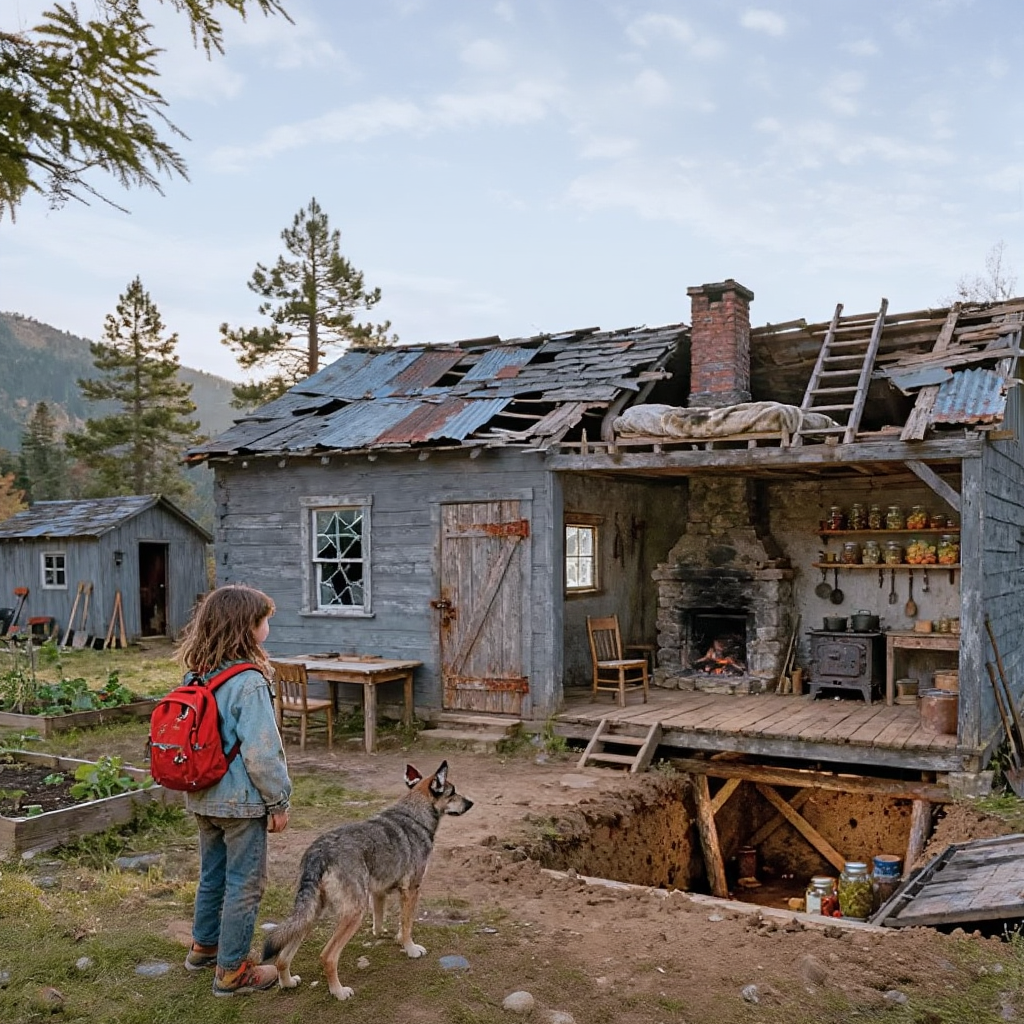
There, barely visible through branches, was a structure.
Small.
Wooden.
Dark.
A cabin.
Her pulse pounded.
Cabin meant roof.
Roof meant warmth.
Or at least shelter from wind.
She approached cautiously.
The cabin looked old but sturdy—hand-hewn logs, metal roof, narrow porch.
A faded American flag hung near the door.
No lights inside.
No vehicles nearby.
She climbed the porch steps slowly.
Knocked once.
No answer.
Knocked again.
Silence.
The door was locked.
But one of the side windows had a cracked pane.
She hesitated.
Breaking in was wrong.
But freezing outside was worse.
She set down her backpack, picked up a small rock, and carefully tapped the cracked corner of the pane.
The glass gave with a soft crunch.
She reached inside and unlocked the window latch.
Her heart thudded in her ears as she climbed in.
Inside, the cabin smelled faintly of cedar and something older—like worn leather.
Moonlight streamed through the window, illuminating a simple interior.
A small wood stove.
A narrow bed.
A wooden table.
Shelves lined with books and military photographs.
She froze.
Photos.
Framed images covered one wall.
Men in uniform.
A younger version of one of them standing proudly beside a helicopter.
Medals displayed in a glass case.
A folded flag in a triangular frame.
This wasn’t an abandoned vacation cabin.
It belonged to a soldier.
Or had.
Ava swallowed.
“I’m sorry,” she whispered into the dark. “I just need to stay warm.”
She set her backpack down and looked for firewood.
A neat stack sat beside the stove.
She’d watched her dad light campfires before deployments.
Small kindling first.
Then larger logs.
It took several attempts.
But finally—
A spark caught.
Flame flickered.
Warmth began to bloom in the small room.
Ava sank onto the floor near the stove and let out a shaky breath.
“This will be our sanctuary,” she whispered.
She didn’t know who “our” was anymore.
But saying it made her feel less alone.
Morning came with pale gold light spilling through pine branches.
Ava blinked awake, disoriented.
Then she remembered.
The cabin.
The fire.
The gas station.
Her stomach growled.
She ate half a granola bar.
Then noticed something on the kitchen counter.
A sealed container labeled “Emergency Rations.”
She hesitated.
Was it okay?
Was she stealing?
She found a note taped underneath.
If you’re reading this, you probably need it more than I do. — C.J.
Her breath caught.
She opened the container.
Inside were protein bars, bottled water, canned soup.
Her hands trembled.
“Thank you,” she whispered.
She explored more carefully in daylight.
The cabin was modest but lived-in.
The bed was made.
A duffel bag sat near the door.
Boot prints marked dried mud near the entry.
Someone had been here recently.
Fear flickered.
What if they came back?
Would they call the police?
Would they send her away?
She stood still, listening.
Nothing.
Just wind through trees.
Then—
Footsteps outside.
Ava’s heart slammed against her ribs.
The door handle turned.
She backed toward the wall.
The door opened slowly.
A tall man in his early thirties stepped inside, wearing worn jeans and a flannel jacket. A trimmed beard framed a serious face.
He froze when he saw her.
She froze too.
For three long seconds, neither spoke.
Then he noticed the broken window.
The lit stove.
The empty water bottle in her hand.
“You alone?” he asked quietly.
She nodded.
His eyes softened, just slightly.
“How old are you?”
“Eleven.”
He closed the door behind him slowly.
“What’s your name?”
“Ava.”
“I’m Caleb Jennings,” he said. “This is my cabin.”
She swallowed.
“I’m sorry. I didn’t mean to break anything. I just… it was cold.”
He glanced at the window again.
Then back at her.
He heated canned soup while Ava sat quietly at the table.
She ate slowly at first.
Then faster.
He noticed she never took more than half of anything offered.
Habit.
Survival.
“You got family?” he asked.
She stared at the spoon.
“My mom.”
“Anyone else?”
She shook her head.
He nodded once.
“Okay.”
Okay?
That was it?
No anger.
No yelling.
Just okay.
After she finished eating, he said gently, “We need to call the sheriff.”
Fear flared in her eyes.
“They’ll put me somewhere.”
“They’ll make sure you’re safe.”
She looked around the cabin.
The stove.
The flag.
The wooden walls.
“This feels safe.”
He studied her carefully.
“You can stay tonight,” he said. “But we have to do this right.”
She nodded slowly.
The sheriff’s department arrived the next afternoon.
A search was launched for her mother.
Security cameras at the gas station confirmed the vehicle’s departure.
Hours turned into days.
No trace.
Ava stayed in the cabin temporarily while social services sorted paperwork.
Caleb insisted.
“She’s not going to a crowded facility if there’s an option,” he told the caseworker.
Background checks were run.
Home evaluations conducted.
Caleb’s military record and clean history worked in his favor.
Weeks passed.
Ava helped stack firewood.
Learned how to fish.
Read books from the cabin shelves—many about survival, resilience, and courage.
At night, she sometimes stared at the folded flag on the wall.
“My dad had one like that,” she said once.
Caleb looked at her gently.
“I know.”
One evening, as snow began to fall lightly again, Ava stood on the porch beside him.
“You didn’t have to let me stay,” she said quietly.
He leaned against the railing.
“Neither did you have to trust me.”
She watched snow settle across the clearing.
“When I saw the cabin,” she admitted, “I thought maybe God left it there for me.”
He smiled faintly.
“Maybe He did.”
She looked up at him.
“Do you think this could really be… a sanctuary?”
He glanced at the trees, the quiet, the smoke curling from the chimney.
“I think sanctuary isn’t a place,” he said. “It’s people.”
Months later, official papers were signed.
Temporary guardianship became permanent.
The gas station lights were far behind them now.
The cabin remained modest.
The stove still needed tending.
The winters were still cold.
But Ava no longer feared freezing.
Because she wasn’t alone in the dark anymore.
On the first anniversary of the night she found the cabin, Ava hung a small sign above the door.
Hand-painted in careful letters:
Sanctuary.
Caleb stood beside her as she hammered the final nail.
“You sure about that name?” he teased gently.
She smiled.
“I knew it the moment I saw it.”
An eleven-year-old girl abandoned at a gas station had walked into the woods.
She could have found danger.
Instead, she found a soldier’s cabin.
And inside it—
Not just warmth.
Not just shelter.
But a place where broken stories could begin again.
“This will be our sanctuary,” she had whispered that first night.
And somehow—
It became exactly that.
The first time Ava heard the howl, she thought it was the wind.
It came in long, hollow notes across the trees—too sharp to be just air moving through pines. Caleb paused mid-step outside the cabin, one hand on the porch post, eyes narrowing toward the ridge line.
“A wolf?” Ava asked, voice small.
Caleb didn’t answer right away. He listened again—measuring distance, direction, the kind of calm that looked practiced.
“Could be,” he finally said. “Could be a coyote. Either way, we stay close tonight.”
Ava nodded and followed him inside.
He checked the latch on the door and the windows like he was sealing a boat before a storm. He didn’t say the words danger or unsafe. He didn’t need to. Ava could read it in his movements.
At bedtime, Caleb set an old baby monitor on the kitchen counter, the kind that looked like it belonged in a thrift store. He clicked it on and carried the other unit toward his room.
“Why do we need that?” Ava asked.
“So I can hear if you get up,” he said, casual.
Ava stared at the monitor, then at him. “Because you think I’ll run?”
Caleb hesitated—just a beat. “Because kids who’ve been left sometimes wake up convinced they’re still alone.”
Ava swallowed. Her throat hurt suddenly, like she’d eaten something too big and dry.
“You won’t be alone,” he added. “Not here.”
She nodded once, but her body didn’t believe it yet.
That night, she dreamed of headlights. Not a car returning—just lights passing her by, one after another, never slowing. She woke up with the taste of metal in her mouth and sat up, breathing fast.
The cabin was dark and quiet.
Except… the monitor.
A crackle. A low murmur. Like a radio picking up a distant voice.
Ava froze. Her heart hammered so hard she thought it might wake Caleb.
The murmur came again.
Then a word.
Not clear.
But human.
Ava slid out of bed and crept to the kitchen doorway, her bare feet cold against the wooden floorboards. Moonlight cut thin stripes across the table. The monitor’s little green light blinked steadily, but the speaker hissed in and out like something was interrupting it.
Ava leaned in close.
And then she heard it—clear enough to make her blood run cold.
“…she’s in there.”
Ava’s entire body went stiff.
Not Caleb’s voice.
Not a sheriff.
Not a caseworker.
A man’s voice—low, distant, and wrong.
Ava backed away from the counter so quickly she bumped the chair. The chair scraped loudly.
The monitor crackled again, but now it was only static.
Ava ran to Caleb’s door and knocked hard.
“Caleb!” she hissed. “Caleb, wake up!”
The door opened instantly, as if he’d been awake the whole time.
His eyes were sharp. Hand already on the doorknob. No confusion. No sleep.
“What is it?” he asked.
Ava’s voice shook. “The monitor… I heard someone. Someone said I’m in here.”
Caleb’s gaze shifted toward the kitchen. He held up a finger for silence.
Ava realized something then: Caleb didn’t treat the woods like a peaceful background.
He treated it like an enemy that could move.
He walked out into the kitchen, quiet as a shadow. He listened. Then he turned off the monitor and set it facedown on the counter like it had betrayed them.
“That monitor picks up other frequencies,” he said quietly. “Truckers. Hunters. Old radios.”
“But I heard—”
“I believe you,” he cut in gently, then softened his tone. “But listening doesn’t mean they’re here.”
Ava’s eyes filled. “What if my mom is looking for me?”
Caleb didn’t answer right away.
He crouched in front of her so their eyes were level. “If your mom comes here, we’ll know. And we’ll handle it together.”
Ava nodded, but her stomach didn’t stop twisting.
Because part of her didn’t want her mom to come back.
And that made her feel like a bad daughter.
The next morning, the sheriff drove up again.
Sheriff Landry was a broad man with a weathered face and a mustache that looked permanently annoyed by the world. He wasn’t unkind, just blunt.
“Morning, kiddo,” he said, tipping his hat slightly at Ava. “You sleep alright?”
Ava hesitated, then nodded.
Caleb stood on the porch, arms crossed. “Any news?”
Landry’s mouth tightened. “We found the vehicle.”
Ava’s breath stopped.
“Where?” Caleb asked.
“Thirty miles east. Off a service road. Empty.”
Ava’s fingers went numb. “My mom…”
Landry held up a hand. “No body. No blood. No obvious struggle. But the gas tank was near empty. And there were footprints around it. Multiple sets.”
Caleb’s eyes narrowed. “How many?”
“Hard to say. Weather’s been messing with tracks.”
Ava clutched the strap of her backpack like it was a lifeline. “So she left the car too?”
Landry looked at her for a long moment, then softened slightly. “Honey, I don’t know. But we’re not stopping. You hear me? We’re not stopping.”
Ava nodded, but her throat burned.
Landry turned to Caleb. “Social services is pushing harder now. They don’t like ‘temporary cabin placement’ turning into ‘semi-permanent living arrangement.’”
Caleb didn’t flinch. “They can push.”
Landry lowered his voice. “They’re talking about moving her to a facility in Helena until they locate a relative.”
Ava’s heart slammed. “No.”
Caleb’s jaw tightened. “Not happening.”
Landry sighed. “I’m just telling you what’s coming, Jennings. They think you’re… an unusual solution.”
Caleb’s eyes flickered to the folded flag on the wall inside, visible through the window.
“Unusual kept her alive,” he said.
That afternoon, a woman arrived in a gray SUV with “Child Services” on the door.
Her name was Ms. Farrow, and her smile looked like something practiced in a mirror. She spoke in a voice that made everything sound reasonable—like the world could be cleaned up with forms and polite sentences.
“Hello, Ava,” she said. “I’m going to ask you a few questions.”
Ava sat at the table, hands folded tight. Caleb stayed nearby, not hovering, but present. The way a soldier stays present.
Ms. Farrow asked the usual things—did Ava feel safe, did Caleb ever yell, did he lock doors, did he touch her, did he scare her.
Ava’s cheeks flushed at the questions. She shook her head quickly. “He’s… he’s nice.”
Ms. Farrow smiled. “Sometimes people seem nice at first.”
Caleb’s voice stayed calm. “That’s enough.”
Ms. Farrow continued anyway.
“Ava, do you want to stay here, or would you feel better somewhere with more children? A facility with counselors, a routine, other girls your age?”
Ava’s vision blurred.
She pictured a crowded room. Fluorescent lights. People watching her sleep. Doors that locked from the outside.
She whispered, “Here.”
Ms. Farrow’s smile tightened. “Sweetheart, you don’t understand what’s best for you.”
Ava’s hands curled into fists.
Caleb stepped forward. “Actually, she does.”
Ms. Farrow turned toward him, tone still polite but colder underneath. “Mr. Jennings, you have been cooperative. But we must follow protocol.”
Caleb nodded once. “Then follow it. Start the guardianship process. I’ll comply with every evaluation. But you are not taking her to a facility like she’s a package to store.”
Ms. Farrow’s eyes narrowed. “That’s not your decision.”
Caleb’s voice dropped. “It will be.”
Ava watched him, heart pounding. She’d never seen an adult speak like that—like someone couldn’t simply decide her life without her.
Ms. Farrow gathered her papers. “We’ll be in touch,” she said, and left without looking at Ava again.
When the SUV disappeared down the dirt road, Ava exhaled shakily.
“I’m sorry,” she whispered. “I’m making your life hard.”
Caleb turned to her. “No. Someone else made your life hard. I’m just here for the part where it gets better.”
That night, Caleb nailed plywood over the cracked window and installed a small motion light on the porch.
“You think someone’s watching?” Ava asked.
Caleb didn’t lie to make her feel better.
“I think when people hear there’s a lone cabin, they get curious,” he said. “And when people hear there’s a child… some get the wrong kind of curious.”
Ava’s skin prickled.
Caleb knelt and met her eyes. “But curiosity doesn’t mean access. Not if I’m here.”
She swallowed. “Were you scared overseas?”
Caleb stared at the trees for a moment. Then he nodded once. “Sometimes.”
“What did you do?”
“I made a plan. Then I followed it.”
Ava nodded slowly, absorbing that like a lesson.
Two days later, the search team found something else.
A backpack.
Not Ava’s.
A woman’s.
It was discovered half-buried near the edge of a ravine.
Sheriff Landry brought it to the cabin in a sealed evidence bag.
Ava recognized it instantly.
Her mother’s blue canvas bag—frayed strap, broken zipper pull.
Ava’s knees buckled. She grabbed the table to stay upright.
“No,” she whispered. “No, no…”
Landry’s voice softened. “We found it near a logging trail. There were signs someone camped there. A little fire ring. Food wrappers.”
“Was she—was she there?” Ava asked.
Landry swallowed. “We didn’t find her yet.”
Caleb placed a hand lightly on Ava’s shoulder, grounding her.
Landry looked at Caleb. “There’s more.”
Caleb’s eyes sharpened. “What?”
Landry lowered his voice. “A man came forward. Said he saw a woman matching her description near the gas station that night. But she wasn’t alone.”
Ava’s stomach turned. “With who?”
Landry hesitated. “He said a man was with her. Older. Beard. Looked like he’d been living rough. The witness thought they argued. Then the woman got into the vehicle with him.”
Ava felt her world tilt.
“My mom wouldn’t—”
Caleb’s voice stayed calm, but his eyes were burning. “What’s the man’s name?”
Landry sighed. “We don’t have one. But we have a direction. And we’re working it.”
Ava’s lips trembled. “So she didn’t just leave me?”
Landry’s gaze softened. “Kid, I don’t know what happened. But I know this: people do strange things when they’re desperate. Doesn’t always mean they stopped loving you.”
Ava’s eyes filled, and the tears finally came—hot and heavy and long overdue.
Caleb didn’t tell her not to cry.
He just stayed close.
That evening, after Landry left, Ava sat by the stove staring into the orange glow.
“Do you think she’s dead?” she whispered.
Caleb sat across from her, elbows on his knees. “I don’t know.”
Ava nodded, wiping her cheek.
“I hate her,” she said suddenly, voice shaking. “And I miss her.”
Caleb’s eyes softened. “Both can be true.”
Ava stared at the folded flag on the wall again.
“My dad would’ve come back,” she whispered.
Caleb’s jaw flexed like the words hit him somewhere deep.
“I served with men like your dad,” he said quietly. “Men who would’ve crawled through fire for their kids.”
Ava looked up. “Then why did my mom—”
Caleb’s voice turned gentle. “Because grief breaks people in different ways.”
Ava’s lips trembled. “I don’t want to be broken.”
Caleb leaned forward slightly. “Then don’t stay in the place that broke you.”
Ava stared at him, breathing shallowly.
“Is that why you came here?” she asked. “To the cabin?”
Caleb looked toward the window, toward the dark woods beyond it.
“Yes,” he admitted.
Ava’s voice went small. “Did it work?”
Caleb was quiet for a long moment. Then he said the truth.
“It worked until you showed up.”
Ava’s heart dropped—then he added, softly:
“And then it worked in a different way.”
Later that night, Ava woke to the motion light snapping on outside.
A bright white beam flooded the porch.
Ava sat up, heart pounding, listening.
Footsteps.
Slow. Heavy.
Not a deer.
Not wind.
Ava slid out of bed and crept toward Caleb’s door.
Before she could knock, the door opened.
Caleb was already dressed. Boots on. Jacket zipped. Like he’d been waiting for war.
He held up a finger for silence.
They moved to the kitchen together, shadows in the dark.
The porch light shone through the window.
And there—standing on the porch—was a man.
Tall. Beard. Dirty coat.
One hand on the railing like he owned it.
Ava’s stomach twisted.
The man leaned toward the door and spoke, his voice carrying through the wood like something poisonous.
“I know you got the little girl in there,” he called.
Ava felt the blood drain from her face.
Caleb’s voice stayed calm, but dangerous. “Back away from my door.”
The man chuckled. “She ain’t yours.”
Ava’s knees shook.
Caleb stepped closer to the door, one hand reaching behind the coat rack—where Ava realized he’d hung something heavy.
A bat.
Ava’s breath caught.
The man’s voice dropped lower, nastier.
“Her mama owes me. And I’m not leaving without what I’m owed.”
Ava’s entire body went cold.
And then the man said the words that made Ava feel like she’d been punched straight through the chest.
“Tell her come out, or I’ll come in and take her anyway.”
Caleb’s grip tightened on the bat.
Ava clutched her backpack strap like it was armor.
And in that instant, she understood that the cabin wasn’t just a sanctuary.
It was a line.
And tonight, someone was trying to cross it.
“You run away?”
She shook her head.
“I got left.”
The words sounded heavier out loud.
Something shifted in his expression.
He set his bag down carefully.
“Left where?”
She told him.
About the gas station.
About waiting.
About the car never coming back.
He listened without interrupting.
When she finished, silence filled the room.
Finally, he walked to the stove and added another log.
“You hungry?” he asked.
She nodded.
Caleb Jennings had served two tours overseas.
After returning home, he found city life too loud.
Too crowded.
Too restless.
So he built the cabin on land left to him by his grandfather.
It was meant to be solitude.
Healing.
Now an abandoned child stood in his living room.