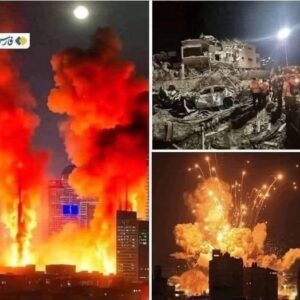
The first missile didn’t just light up the radar. It shattered an illusion. In seconds, a “routine” transit through the Strait of Hormuz erupted into a duel that Iran thought it could control—but never truly understood. As encrypted orders crackled through Iranian channels, one phrase sealed their fate.
The package was on its way, and the clock had already star… Continues…
When the first Iranian anti-ship missiles arced off the coast at 2:31 PM, the sky over the Strait of Hormuz turned into a lattice of contrails and fire.
A dozen missiles lunged toward the USS Theodore Roosevelt and her escorts. Within seconds,
When the first Iranian anti-ship missiles arced off the coast at 2:31 PM, the sky over the Strait of Hormuz turned into a lattice of contrails and fire. A dozen missiles lunged toward the USS Theodore Roosevelt and her escorts. Within seconds, Aegis-equipped destroyers lit up, launching SM-2 interceptors, while close-in weapons systems spun to life, spitting tungsten at supersonic threats. On the Roosevelt’s bridge, Captain Chen watched the unfolding chaos with a cold, practiced focus, his crew executing years of drilled reflexes in real time.
By minute twelve, more than half the incoming missiles had been swatted from the sky. The few that broke through met layers of electronic warfare, decoys, and last-ditch defenses. None reached the carrier. Then came the American reply. From beyond Iran’s visual horizon, Tomahawk cruise missiles roared in low, followed by precision airstrikes from Roosevelt’s fighters. In under half an hour, the coastal batteries that had fired so confidently were silent ruins. Iran had tested the carrier’s defenses—and discovered, brutally, that the real lesson was not American vulnerability, but American restraint. The world’s most dangerous chokepoint had flared, then quieted, leaving only burned concrete, scattered wreckage, and a chilling understanding: miscalculation in these waters doesn’t end in stalemate. It ends in seconds.
When the first Iranian anti-ship missiles arced off the coast at 2:31 PM, the sky over the Strait of Hormuz turned into a lattice of contrails and fire. A dozen missiles lunged toward the USS Theodore Roosevelt and her escorts. Within seconds, Aegis-equipped destroyers lit up, launching SM-2 interceptors, while close-in weapons systems spun to life, spitting tungsten at supersonic threats. On the Roosevelt’s bridge, Captain Chen watched the unfolding chaos with a cold, practiced focus, his crew executing years of drilled reflexes in real time.
By minute twelve, more than half the incoming missiles had been swatted from the sky. The few that broke through met layers of electronic warfare, decoys, and last-ditch defenses. None reached the carrier. Then came the American reply. From beyond Iran’s visual horizon, Tomahawk cruise missiles roared in low, followed by precision airstrikes from Roosevelt’s fighters. In under half an hour, the coastal batteries that had fired so confidently were silent ruins. Iran had tested the carrier’s defenses—and discovered, brutally, that the real lesson was not American vulnerability, but American restraint. The world’s most dangerous chokepoint had flared, then quieted, leaving only burned concrete, scattered wreckage, and a chilling understanding: miscalculation in these waters doesn’t end in stalemate. It ends in seconds.
When the first Iranian anti-ship missiles arced off the coast at 2:31 PM, the sky over the Strait of Hormuz turned into a lattice of contrails and fire.
A dozen missiles lunged toward the USS Theodore Roosevelt and her escorts. Within seconds,
Aegis-equipped destroyers lit up, launching SM-2 interceptors, while close-in weapons systems spun to life,
spitting tungsten at supersonic threats. On the Roosevelt’s bridge, Captain Chen watched the unfolding chaos with a cold,
practiced focus, his crew executing years of drilled reflexes in real time.
By minute twelve, more than half the incoming missiles had been swatted from the sky.
The few that broke through met layers of electronic warfare, decoys, and last-ditch defenses.
None reached the carrier. Then came the American reply. From beyond Iran’s visual horizon,
Tomahawk cruise missiles roared in low, followed by precision airstrikes from Roosevelt’s fighters.
In under half an hour, the coastal batteries that had fired so confidently were silent ruins.
Iran had tested the carrier’s defenses—and discovered, brutally, that the real lesson was not American vulnerability,
but American restraint. The world’s most dangerous chokepoint had flared, then quieted, leaving only burned concrete, scattered wreckage, and a chilling understanding: miscalculation in these waters doesn’t end in stalemate. It ends in seconds.
Aegis-equipped destroyers lit up, launching SM-2 interceptors, while close-in weapons systems spun to life, spitting tungsten at supersonic threats. On the Roosevelt’s bridge, Captain Chen watched the unfolding chaos with a cold, practiced focus, his crew executing years of drilled reflexes in real time.
By minute twelve, more than half the incoming missiles had been swatted from the sky. The few that broke through met layers of electronic warfare, decoys, and last-ditch defenses. None reached the carrier. Then came the American reply. From beyond Iran’s visual horizon, Tomahawk cruise missiles roared in low, followed by precision airstrikes from Roosevelt’s fighters. In under half an hour, the coastal batteries that had fired so confidently were silent ruins. Iran had tested the carrier’s defenses—and discovered, brutally, that the real lesson was not American vulnerability, but American restraint. The world’s most dangerous chokepoint had flared, then quieted, leaving only burned concrete, scattered wreckage, and a chilling understanding: miscalculation in these waters doesn’t end in stalemate. It ends in seconds.