In a moment that left even seasoned White House reporters surprised, former President Donald Trump singled out a question during a recent press conference as “the best question I’ve ever been asked.” The inquiry, which concerned a leading economist’s dramatic shift in perspective about Trump’s controversial tariff strategy, provided the former president with a rare opportunity to vindicate a key pillar of his economic policy.
The question referenced economist Torsten Sløk of Apollo Global Management, who had initially warned that Trump’s tariffs could precipitate a recession but recently acknowledged that the strategy may have, in his words, “outsmarted everyone.”
Trump’s face lit up as the reporter asked, “Mr. President, a leading global economist just did a one-eighty and says your tariff plan, you may have outsmarted everybody with it. What is your message?”
Clearly relishing the moment, Trump responded enthusiastically, “I love this. I love this question. This is the favorite. This is the best question I’ve ever been asked because I’ve been going through abuse for years on this.”
He continued, defending his approach to trade: “Because, as you know, we’re taking in hundreds of billions of dollars, no inflation whatsoever.”
When pressed on what he would say to his critics who long argued the tariffs would damage the U.S. economy, Trump didn’t hold back: “I think they should go back to business school. It’s so obvious. It’s so obvious. I mean, we’re taking in billions and billions of dollars from China and a lot of other countries.”
The moment came as U.S. stock markets soared to record highs, with the S&P 500 and Nasdaq both posting historic closing figures. It provided a timely backdrop to the renewed debate over Trump’s long-standing trade policies.
Trump’s tariffs, imposed shortly after his inauguration in January, targeted major U.S. trading partners, including China, Canada, and Mexico. Despite intense criticism from economists, lawmakers, and foreign leaders, Trump insisted his plan would ultimately benefit American workers and businesses by leveling the playing field. Over time, the initial shock of the policy gave way to nuanced discussions about its actual economic impact.
At the time, many economists warned that such protectionist policies could trigger retaliatory measures, increase consumer prices, and ultimately lead the U.S. into a recession. Torsten Sløk was among them. Many experts cited disruptions in supply chains, strained international relations, and potential long-term harm to global trade norms.
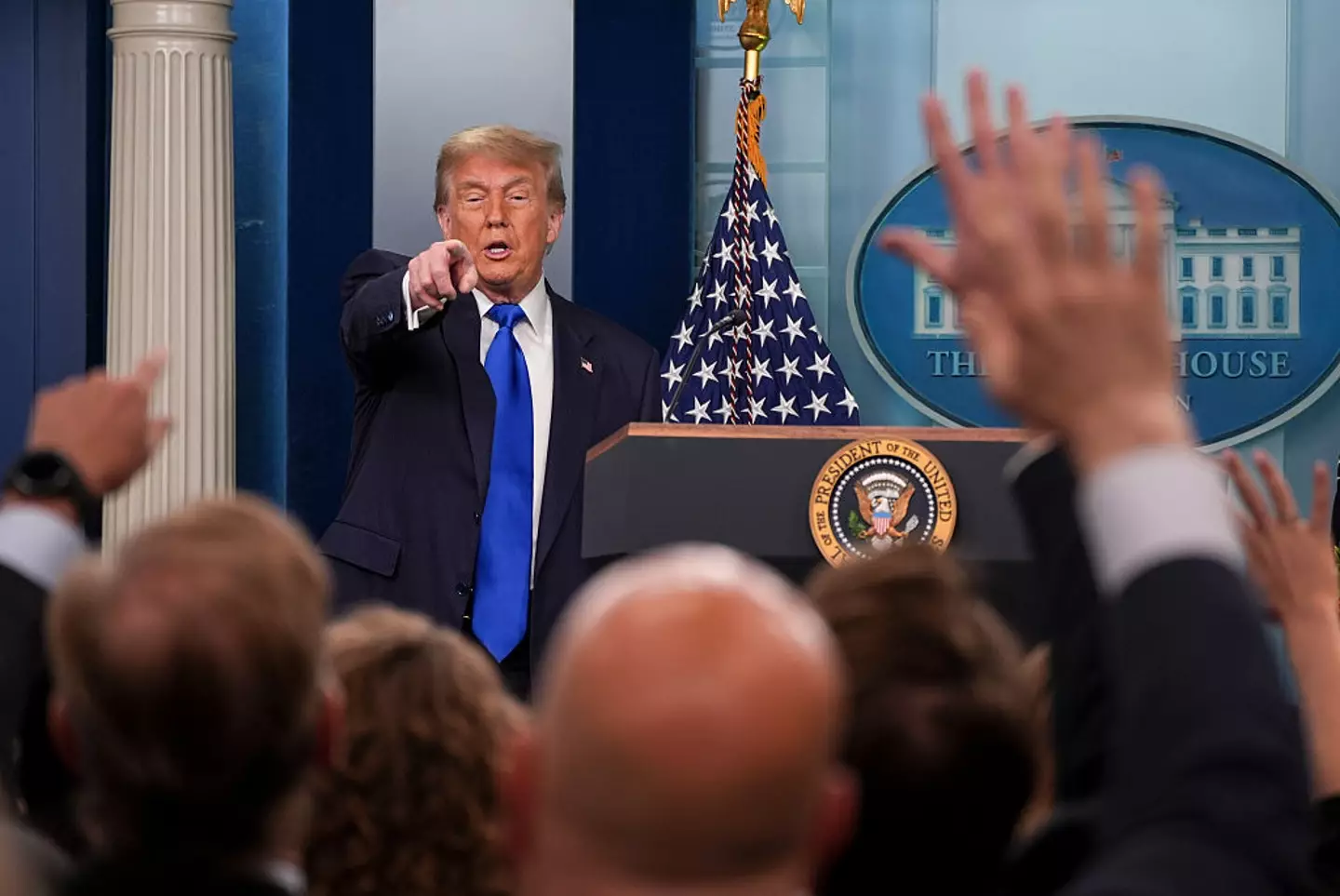
Donald Trump said it was his ‘favorite question’ (Demetrius Freeman/The Washington Post via Getty Images)
However, in a June 21 post on Apollo Academy’s blog, Sløk offered a dramatically revised interpretation of Trump’s approach. He speculated that the administration’s long-term objective might be a calculated reshaping of global trade dynamics, using high tariffs as leverage to force structural changes.
“Maybe the strategy is to maintain 30 percent tariffs on China and 10 percent tariffs on all other countries and then give all countries 12 months to lower non-tariff barriers and open up their economies to trade,” Sløk wrote. His remarks hinted at a deeper strategic framework within the Trump administration that had previously gone unacknowledged.
He suggested that such a move could stabilize business planning, reduce uncertainty, and ultimately strengthen both employment and financial markets. A long-term horizon for adjustments could provide relief and clarity for both U.S. and international stakeholders navigating the shifting trade landscape.
Sløk added: “This would seem like a victory for the world and yet would produce $400 billion of annual revenue for US taxpayers. Trade partners will be happy with only 10% tariffs and US tax revenue will go up. Maybe the administration has outsmarted all of us.”
For Trump, Sløk’s revised analysis felt like vindication. It played directly into his narrative that, despite widespread skepticism, his policies were delivering tangible results. The former president has frequently framed his decision-making as intuitive, outside the box, and ultimately more aligned with America’s core interests than the predictions of established experts.
Indeed, the administration often pointed to increasing tax revenue from tariffs and job growth as evidence that its economic vision was bearing fruit. Supporters have long maintained that the tariffs forced countries like China to the negotiating table, while critics argued the burden largely fell on American consumers and importers. Trump, however, has continuously asserted that it was foreign companies who paid the tariffs, not American businesses or citizens.
Still, with the stock market rallying and the economy showing signs of strength, the question of whether Trump’s trade war was ultimately a success has taken on new urgency. Sløk’s comments are likely to amplify that discussion, encouraging policymakers and analysts alike to revisit earlier assumptions and reassess data with a fresh perspective.
“I remember all the criticism,” Trump said during the same press conference. “Every television network. Every newspaper. They all said it would be a disaster. Now look. The markets are higher than ever, and we have leverage we never had before.”
The president also stressed that there had been no measurable inflation, a point many economists dispute. “They said prices would go up. They didn’t. Look at the data. We’re winning,” Trump declared. However, some economists note that while certain categories saw minimal increases, others—particularly imported goods and materials—did experience price shifts that may have flown under the broader radar.
His remarks reflect a long-standing theme in Trump’s economic rhetoric: that traditional economists, globalists, and political elites underestimate his instincts. The idea that his unconventional tactics might prove correct despite criticism has become a recurring motif. He often presents himself as someone willing to take the hard, unpopular decisions to safeguard American strength.
The viral moment also served as political capital. As Trump continues to campaign and shape his legacy, moments like these allow him to reinforce the image of being a disruptor who took on entrenched interests and won. For his base, such gestures symbolize vindication not just for Trump, but for their shared values and belief in his leadership.
For some, Sløk’s turnaround confirms what they’ve believed all along. For others, it raises questions about how economic assessments are shaped by evolving data, market movements, and geopolitical shifts. It also highlights how narratives can pivot dramatically based on new evidence or interpretations of old policies.
Regardless, Trump’s gleeful reaction underscores just how much he values recognition from unlikely places. As he put it, “It’s not about being right all the time. It’s about doing what’s right for America, even when it’s hard.”
In today’s rapidly changing global economy, where strategies are reassessed and alliances are redefined, this exchange may serve as a reminder that what is dismissed as reckless by some can, under certain conditions, be reconsidered as innovative by others. Whether Trump’s tariffs truly outsmarted the world remains debatable. But the conversation they sparked continues to reshape the narrative around economic leadership and global trade policy.
Even as debates persist, one thing is clear: the Trump era ushered in a new willingness to challenge orthodoxies on trade and economics. Whether one views that legacy as bold or brash, the ripple effects are still unfolding. Sløk’s pivot may not close the book on this chapter, but it certainly adds a compelling footnote.